
AAS Suite - designer and marketplace for Asset Administration Shells
You want to create Asset Administration Shells (AAS) and are
looking for the right tool for it?
Our AAS Suite with the AAS Designer enables the
easy and fast creation, editing and validation of Asset
Administration Shells on the web as well as publishing on the
AAS Marketplace.
The Designer enables easy creation of an AAS, even for non-experts.
If desired, it guides the author step by step through building an Asset Administration Shell with basic submodels (such as Digital Nameplate and Handover Documentation) and offers many assistance functions.
Experienced users also get a tool that allows Asset Administration Shells to be created, validated and edited quickly and easily. After finishing, you can be sure that you have a correct AAS.
These AAS can be shared within the Designer with colleagues
in your own company or published on the Marketplace.
In addition, finished AAS can be deployed and instantiated
from the Designer into an AAS Registry/AAS Repository
system.
Currently implemented submodels of the
IDTA
Meta-Level Software AG is a member of the IDTA - Industrial Digital Twin Association. The IDTA continuously provides new submodels for AAS. These submodels are essential for the content structure of an AAS. We continuously work to make the released IDTA submodels available in our AAS Designer.
It is also possible to create your own submodels or modify the existing ones and work with them.
Marketplace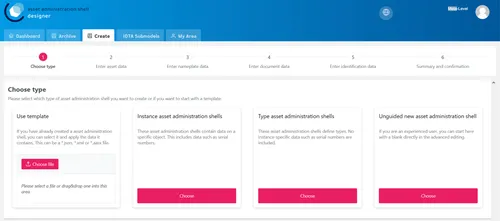

The AAS Designer was developed within the BMBF-funded project "BaSys überProd".
designer.aas-suite.com
The Marketplace for Asset Administration Shells is the central hub for providing and exchanging AAS.
On the marketplace, users can research published AAS and download them as an AASX package in order to use them.
It is possible to load AAS from the marketplace into the Designer and process them further. AAS created in the Designer can be published on the marketplace at the push of a button.
Viewer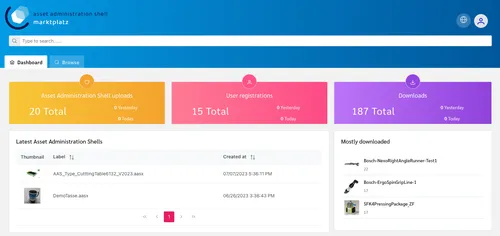
With the Viewer, data stored in an AAS can be made readable and viewed.
The Viewer, which is included in the AAS Designer, Marketplace, Compare Tool and Reader, displays the content of an Asset Administration Shell in a fast, easy-to-read and visually appealing view.
For example, measurement data that is available as time series data can be loaded for a selectable period and clearly displayed in a chart.
Reader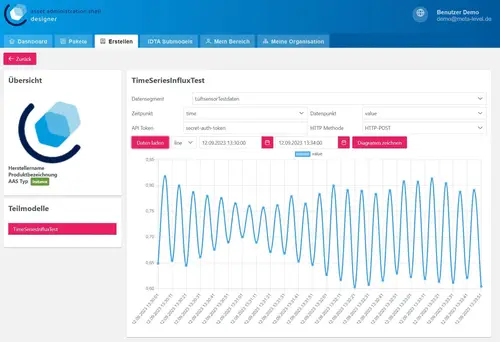
With the Reader, information stored as a QR code in an AAS can be made readable and viewed.
The Reader is an extension of the Viewer included in the AAS Designer and Marketplace.
In the Marketplace, a link and a QR code can be generated for each published AAS. By scanning the QR code with the AAS Reader, the contents of the AAS are displayed in the Viewer in a readable and visually appealing form.
Feed Application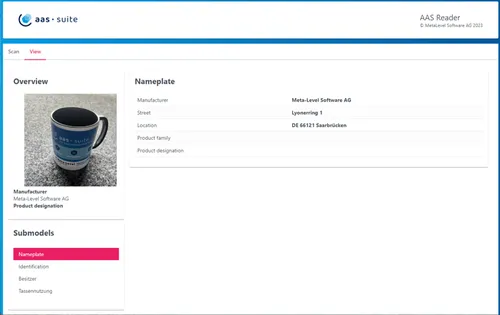
With the Feed Application, AAS can be generated automatically with ease.
To generate an AAS for each individual product in production, creating Asset Administration Shells manually is not feasible due to the large volume. For this reason, the AAS Designer provides the Feed Application, which can automatically generate AAS.
Based on a type AAS as a kind of template, values for the fields are defined in the various submodels. This determines where the data should come from and how it should be linked to external data sources. You choose once from different methods for how data should be inserted, for example by a fixed value, a function call, a web service call, or from a CSV file, etc. This makes it possible to create large volumes of product AAS (instances) at the push of a button or automatically via the integrated REST API.
Compare Tool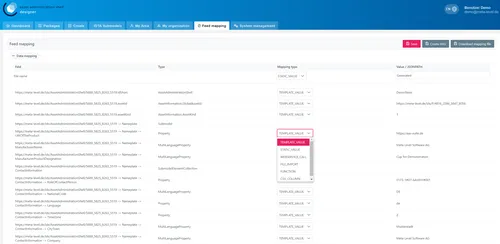
With the Compare Tool, it is possible to compare Asset Administration Shells with each other.
An important concept of the Asset Administration Shell is the standardized data structure. This allows assets to be compared, for example, in terms of their technical specifications, operating data (energy consumption, efficiency in certain areas etc.), interoperability, extensibility, security characteristics, compliance and certifications, and much more.
compare.aas-suite.com shows a freely usable example application of what such a comparison can look like. Currently, the submodels Technical Data, Article Information and part of the Digital Nameplate are compared. The IDTA-compliant API of the AAS enables this comparison for AAS from different repositories of various providers.
Services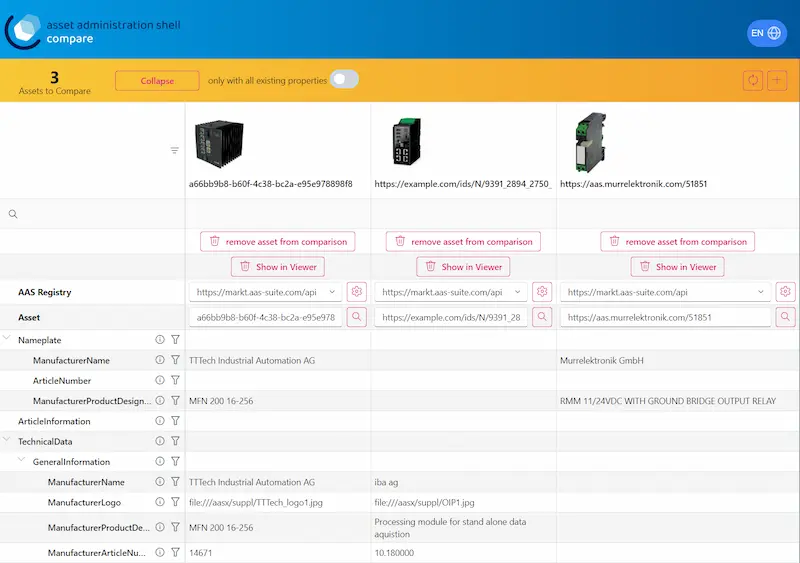
We support you with our software services in the AAS domain.
We also offer additional services in the AAS domain: Do you want to learn about the possibilities of using AAS, set up initial projects with it or carry out a proof of concept? Do you need help building a software infrastructure to work with AAS and use it productively in your company? Or do you need a specific, tailor-made software solution? We can support you here as well!
Contact usThe idea and motivation behind developing the AAS Suite
AAS - the future standard for interfaces to machines, their components and assets
The Asset Administration Shell (AAS) is designed as the future standard for data communication between machines and IT systems in Industry 4.0 environments. It is used as a standardized interface between all kinds of industrial machines, including robots, production lines, conveyor systems, etc., and their respective components or parts. The integration and interaction of processes or virtual assets is also possible. AAS serves as the content basis for the conception and creation of digital twins, i.e. AAS is their data representation.
The definition of this interface and the accompanying concept has been advanced and developed in recent years through projects funded by the Federal Ministry of Education and Research (BMBF) (e.g., BaSys 4.x). To establish this standard in everyday use, a large group of renowned companies has founded an association, the IDTA - Industrial Digital Twin Association (currently over 100 members).
The software
Building an Asset Administration Shell is usually quite complicated. The documentation of the definition comprises several hundred pages. An AAS usually consists of several submodels that represent different aspects of an asset. To create these and fill them with meaningful content, you need experts who deal with the topic extensively. This is, of course, not desirable for a standard.
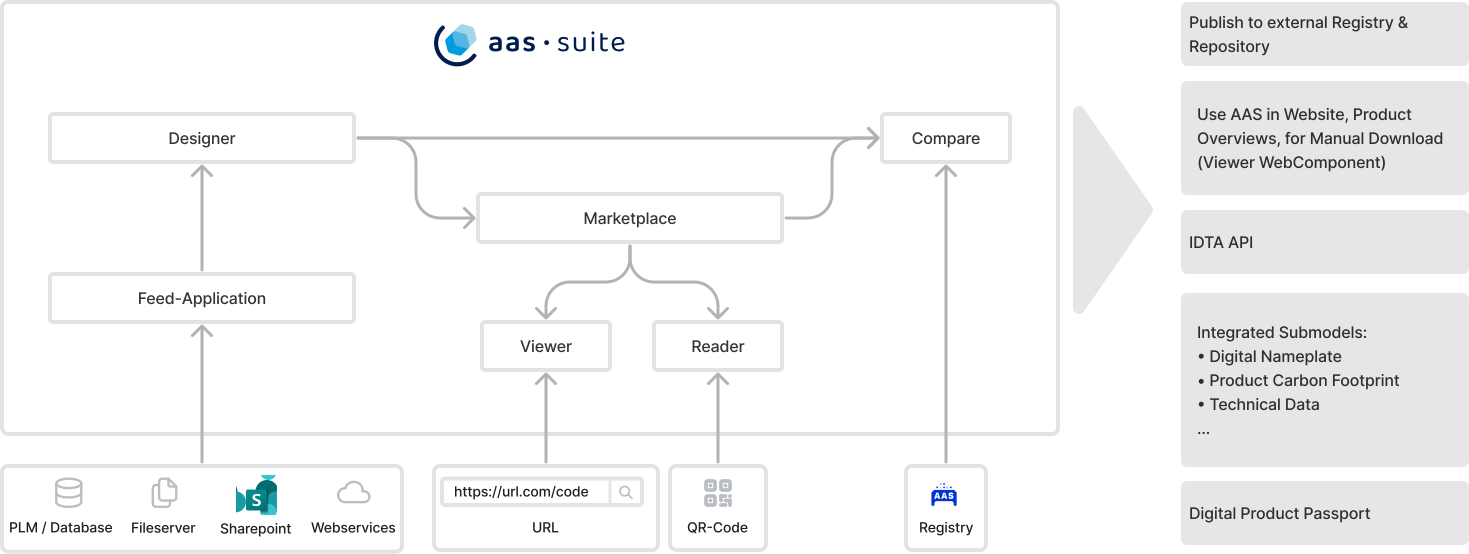
Therefore, Meta-Level Software AG offers the AAS Designer, which supports users in creating an Asset Administration Shell easily and quickly. With a variety of assistance functions and guidance, the Designer leads users through the entire creation of an AAS and thus already prevents many possible errors. Additionally, there is an expert mode in which experienced users can also quickly create and edit their own Asset Administration Shells. Within the Designer, Asset Administration Shells can be shared internally. Via the AAS Marketplace, an AAS can be made publicly available.
The tools of the AAS Suite with the Designer are available in the current IDTA-published version 3 of the AAS specification!
Contact us
Would you like to learn more about the AAS Suite or have other questions?
Then feel free to send us a message via our contact form or
call us at
+49 681 99687-0.